
Readiness report
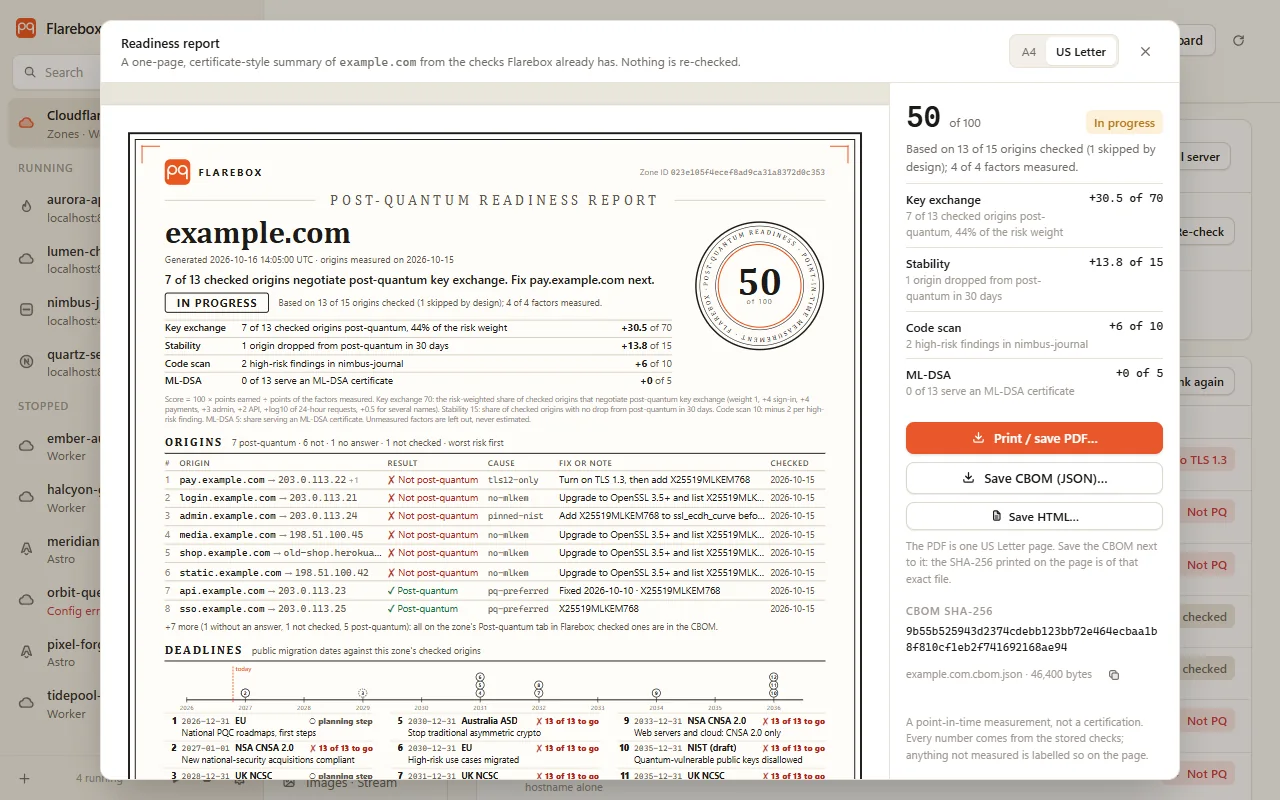
Readiness report on a zone’s Post-quantum tab builds one page a security lead can hand to their manager: a score, which origins are fixed and which aren’t, the public deadlines, and the cryptography inventory. It’s built only from what Flarebox already stored (the zone’s DNS origins, the post-quantum history, the risk weights, a local code scan of projects routed to the zone, and the CBOM). It runs no checks.
The score
Section titled “The score”0–100. Every factor is a line on the page, and the formula is printed underneath in small type.
| Factor | Points | What earns them |
|---|---|---|
| Key exchange | 70 | The risk-weighted share of checked origins that negotiate post-quantum. The weights are those of Fix these first, so an unfixed sign-in origin costs more than a static host |
| Stability | 15 | The share of checked origins with no drop from post-quantum in 30 days |
| Code scan | 10 | Minus 2 per high-risk finding in local projects routed to the zone |
| ML-DSA | 5 | The share of origins serving an ML-DSA certificate |
A factor without data is printed not measured and left out of both sides, never estimated. With no origin checked there’s no score. The grade is in words: Ready (90 or more, every origin checked and post-quantum, no regression), Mostly ready (70 or more), In progress, or Not started.
The page
Section titled “The page”A4 or US Letter, portrait, always exactly one page:
- the zone, when it was generated, a one-line verdict, the score seal and the factor lines;
- Origins, worst risk first, each with its result, cause, one-line fix and check date (with more than eight: the worst six, two post-quantum ones, and “+N more”);
- Deadlines: a 2026–2036 timeline of the twelve public milestones and where the zone stands against each;
- Cryptography inventory: algorithms by family, how many origins use each, and the SHA-256 of the exported CBOM, so the PDF and the JSON can be matched;
- a footer with what was measured and what wasn’t, the Flarebox and pqdoctor versions, and “A point-in-time measurement, not a certification.”
There’s no Cloudflare logo and no wording that suggests anyone endorses it. It reads the same in greyscale: ✓, ✗, ◆ and ○ carry the meaning, not colour.
Saving
Section titled “Saving”| Button | Saves |
|---|---|
| Save PDF… | The page, printed by WebView2’s own PrintToPdf in a hidden window with JavaScript off. Flarebox checks the PDF has exactly one page before saving it |
| Save CBOM (JSON)… | The exact CycloneDX 1.6 file whose SHA-256 is on the page |
| Save HTML… | The self-contained page: no scripts, no outside files |
The Save dialog is Windows’ own, so it asks before replacing a file.