
Post-quantum tab
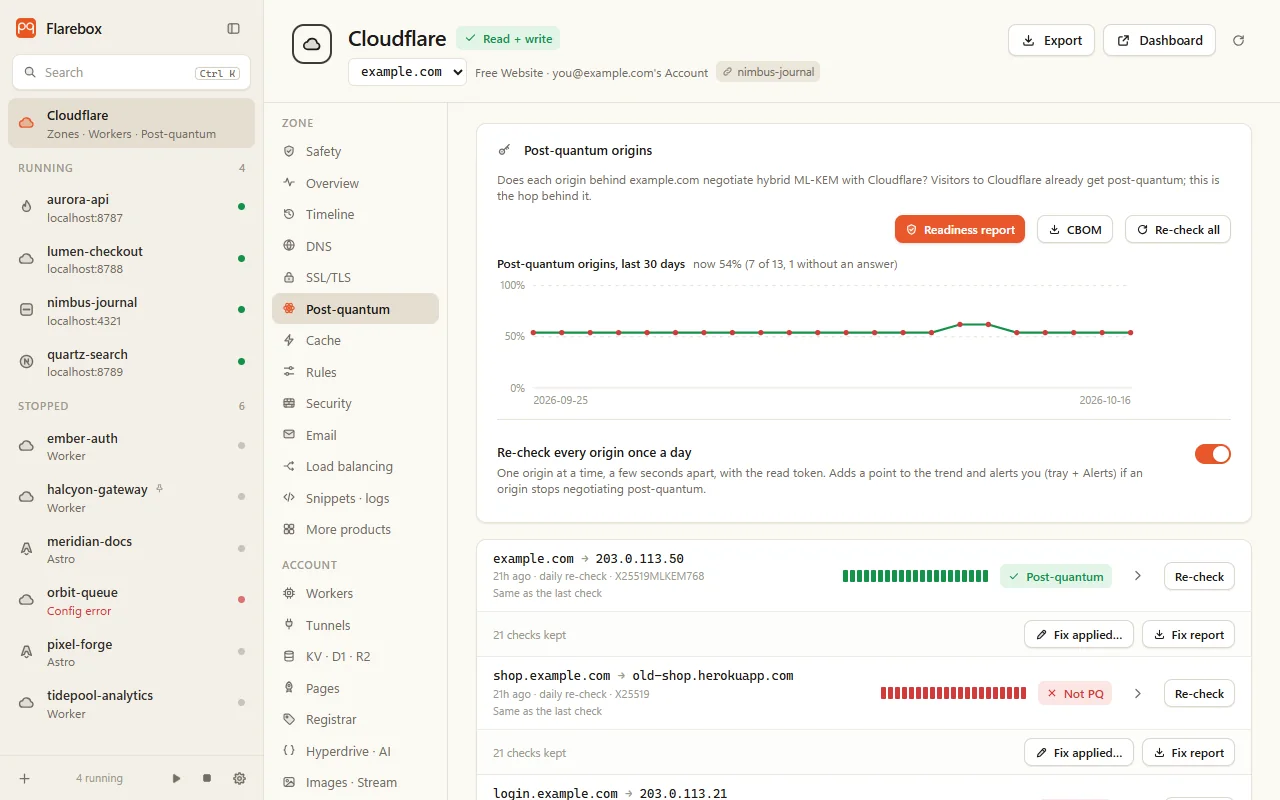
Each zone has a Post-quantum tab. It keeps every check of every origin, so it can say what changed, prove a fix worked, and catch a regression. The same tab has the zone’s mail servers and the one-page readiness report.
History
Section titled “History”Every pqdoctor result is kept, whether it came from a project’s hosts, the “Check any host” box, a zone’s origins or the daily re-check. Only results are stored: hostnames, addresses and what the handshakes said. No tokens.
An origin is keyed by both its name and its address (origin:<sni>@<address>), since that’s what was checked. At most 500 checks are kept per key.
Each new check is compared with the one before it:
| Change | Means |
|---|---|
| first | No earlier check |
| same | Nothing changed |
| fixed | Wasn’t post-quantum, now is |
| regressed | Was post-quantum, now isn’t |
| changed | Something else changed, e.g. “Key exchange X25519 → X25519MLKEM768” |
| no answer | Unreachable this time. That doesn’t count as a regression; the last real answer stands |
Daily re-check
Section titled “Daily re-check”Every hour, Flarebox re-checks each origin that hasn’t been checked for a day, one at a time and 3 s apart, with the read token. It’s on by default and can be switched off.
An origin that was post-quantum and isn’t any more raises an alert in the tray and on the Alerts tab, with a link back here.
Fix reports
Section titled “Fix reports”- Fix applied…: record what you changed. It’s pre-filled with pqdoctor’s first suggested fix.
- Re-check the origin.
- Fix report: a self-contained before/after page with the cause, the fix you recorded and when, and the new result, side by side. It prints to PDF. It has no scripts and no outside links.
Per day, the share of the zone’s origins that negotiate post-quantum. Each origin’s last known answer carries forward, and days with no answer are left out of the share.
A CycloneDX 1.6 cryptography bill of materials from the latest results. For each host: the TLS protocol, its key exchange group, the cipher suite’s algorithms, and the certificate with its signature algorithm and public key, each a cryptographic-asset component, joined by dependencies.
A hybrid depends on its parts (X25519MLKEM768 → ML-KEM-768 + X25519), with OIDs and NIST quantum security levels (0 for the classical ones). SSH servers get an ssh protocol component linked to the key exchange methods they offer. Nothing is guessed about hosts that didn’t answer.
The tests validate the CBOM against the official CycloneDX 1.6 schema.
Fix these first
Section titled “Fix these first”Each origin that isn’t post-quantum is scored by what it serves: sign-in, payment, admin and API names and paths count most, weighted by traffic over the last 24 hours. Ranking by paths needs Zone → Analytics → Read. Without it, Flarebox ranks by hostname and says what to add.
Deadlines
Section titled “Deadlines”12 dated milestones from NIST IR 8547 (initial public draft), CNSA 2.0 and its FAQ, the EU roadmap v1.1, the UK NCSC and Australia’s ASD. Each has its source link and a short exact quote, and is measured against the zone’s latest results:
| Date | Who |
|---|---|
| 2026-12-31 | EU |
| 2027-01-01 | NSA (US national security systems) |
| 2028-12-31 | UK NCSC |
| 2030-12-31 | NIST · Australia ASD · EU |
| 2031-12-31 | UK NCSC · NSA |
| 2033-12-31 | NSA |
| 2035-12-31 | NIST · UK NCSC · EU |
- Planning milestones say they’re planning steps.
- CNSA 2.0 milestones count only ML-KEM-1024. Hybrid ML-KEM-768 doesn’t meet them.
- “All algorithms” milestones need both post-quantum key exchange and an ML-DSA certificate.
ssh://host or host:22 in “Check any host” runs the SSH check, with the same history, fix report and CBOM as TLS hosts.